
Understanding The Importance Of Financial Education
Understanding the importance of financial education is a central theme in Robert Kiyosaki’s influential book, ”Rich Dad Poor Dad.” The book contrasts the financial philosophies of Kiyosaki’s two father figures: his biological father, whom he refers to as his ”Poor Dad,” and the father of his best friend, whom he calls his ”Rich Dad.” Through their differing approaches to money and investing, Kiyosaki illustrates key lessons on building wealth that are both insightful and practical.
One of the primary lessons from ”Rich Dad Poor Dad” is the significance of financial literacy. Kiyosaki emphasizes that traditional education often falls short in teaching individuals how to manage money effectively. While schools focus on academic and professional skills, they rarely cover essential financial concepts such as investing, saving, and understanding assets and liabilities. Kiyosaki argues that this gap in education leaves many people ill-prepared to handle their finances, leading to poor financial decisions and missed opportunities for wealth accumulation.
To bridge this gap, Kiyosaki advocates for self-education in financial matters. He suggests that individuals take the initiative to learn about money management, investment strategies, and the principles of wealth creation. By doing so, they can make informed decisions that will help them achieve financial independence. This proactive approach to financial education is a cornerstone of Kiyosaki’s philosophy and is crucial for anyone looking to build and sustain wealth.
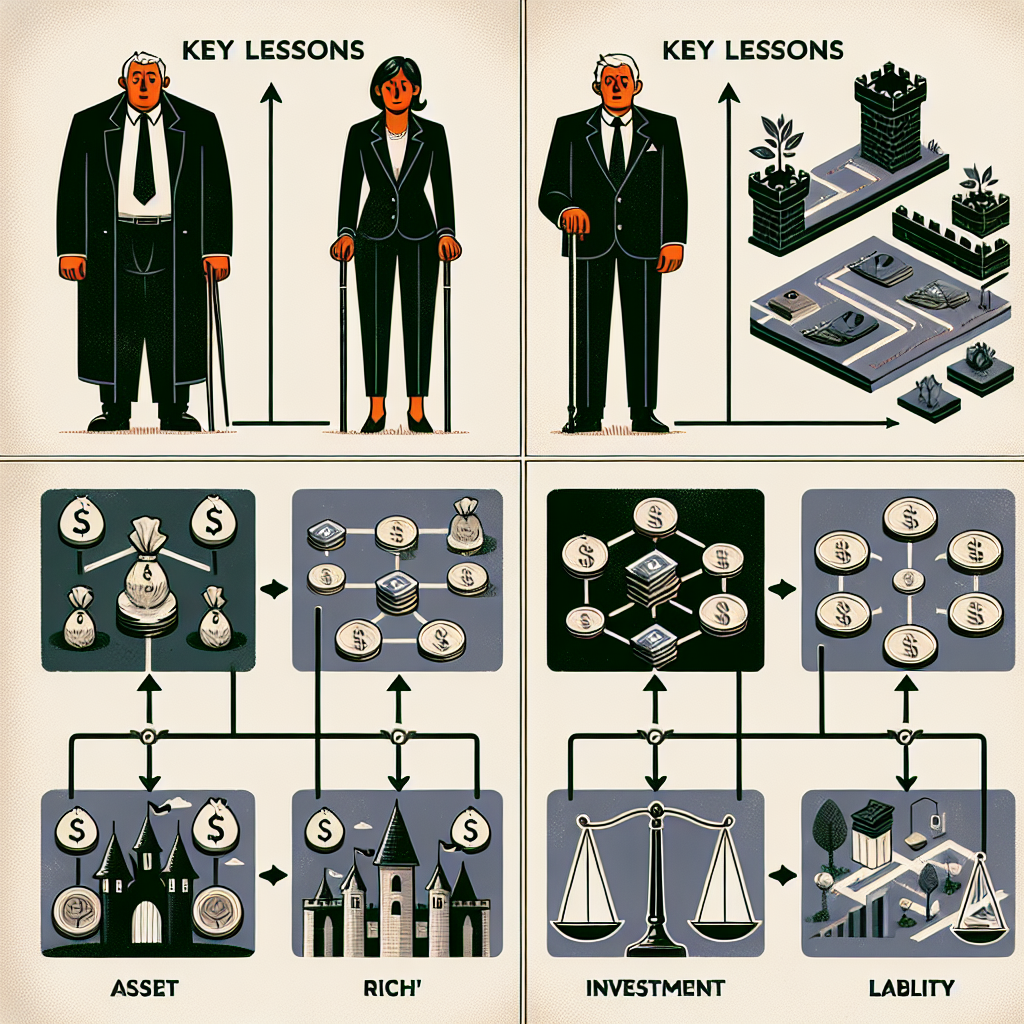
Another key lesson from the book is the importance of understanding the difference between assets and liabilities. Kiyosaki’s ”Rich Dad” teaches him that assets are things that put money in your pocket, while liabilities are things that take money out of your pocket. This simple yet profound distinction helps individuals focus on acquiring assets that generate income, such as real estate, stocks, and businesses, rather than accumulating liabilities that drain their resources. By prioritizing the acquisition of income-generating assets, individuals can create multiple streams of income and build a solid financial foundation.
In addition to understanding assets and liabilities, Kiyosaki highlights the value of entrepreneurship and investing. He encourages readers to think beyond the traditional path of working for a paycheck and to explore opportunities for creating passive income. Whether through starting a business, investing in real estate, or participating in the stock market, Kiyosaki believes that taking calculated risks and being entrepreneurial can lead to significant financial rewards. This mindset shift from employee to entrepreneur is essential for those who aspire to achieve financial freedom.
Moreover, Kiyosaki underscores the importance of mindset in building wealth. He explains that a positive and proactive attitude towards money is crucial for financial success. By adopting a mindset of abundance and possibility, individuals can overcome financial challenges and seize opportunities that others might overlook. This mental shift is often the first step towards transforming one’s financial situation and achieving long-term wealth.
In conclusion, ”Rich Dad Poor Dad” offers valuable lessons on the importance of financial education, understanding assets and liabilities, embracing entrepreneurship, and cultivating a wealth-building mindset. By applying these principles, individuals can take control of their financial future and work towards achieving financial independence. Kiyosaki’s insights serve as a powerful reminder that financial success is not solely determined by one’s income but by one’s knowledge, mindset, and strategic actions.
The Power Of Passive Income And Investments

In ”Rich Dad Poor Dad,” Robert Kiyosaki delves into the contrasting financial philosophies of his two father figures, offering readers invaluable insights into building wealth. One of the most compelling lessons from the book is the power of passive income and investments. Kiyosaki emphasizes that while active income, earned through traditional employment, is essential, it is the strategic creation of passive income streams that truly paves the way to financial independence.
To begin with, Kiyosaki introduces the concept of passive income as money earned with minimal effort. This can come from various sources such as rental properties, dividends from stocks, or royalties from intellectual property. Unlike active income, which requires continuous effort and time, passive income allows individuals to earn money even while they sleep. This shift in mindset from working for money to having money work for you is a cornerstone of Kiyosaki’s financial philosophy.
Transitioning from the idea of passive income, Kiyosaki also underscores the importance of investments. He argues that investing is not just for the wealthy; anyone can start with small amounts and gradually build their portfolio. The key is to educate oneself about different investment opportunities and to take calculated risks. Kiyosaki’s rich dad taught him that investing in assets that generate income, such as real estate or stocks, is crucial for long-term wealth accumulation. This approach contrasts sharply with his poor dad’s belief in job security and saving money in a bank, which often yields minimal returns.
Moreover, Kiyosaki highlights the significance of financial education. He believes that understanding how money works is essential for making informed investment decisions. This involves learning about financial statements, market trends, and the principles of risk and reward. By becoming financially literate, individuals can identify lucrative opportunities and avoid common pitfalls. Kiyosaki’s rich dad encouraged him to read books, attend seminars, and seek mentorship from successful investors, thereby equipping him with the knowledge needed to navigate the complex world of finance.
In addition to financial education, Kiyosaki stresses the importance of a proactive mindset. He advises readers to adopt an entrepreneurial spirit, constantly seeking ways to create and grow their wealth. This involves being open to new ideas, embracing change, and not being afraid to fail. Kiyosaki’s rich dad taught him that failure is a part of the learning process and that each setback provides valuable lessons. By maintaining a positive attitude and staying persistent, individuals can overcome obstacles and achieve their financial goals.
Furthermore, Kiyosaki discusses the role of tax advantages in wealth building. He explains that the wealthy often leverage tax laws to their benefit, reducing their tax liabilities through investments in real estate, businesses, and other ventures. By understanding and utilizing these tax strategies, individuals can retain more of their earnings and reinvest them to generate additional income. This approach not only accelerates wealth accumulation but also provides a legal and ethical way to optimize one’s financial situation.
In conclusion, Robert Kiyosaki’s ”Rich Dad Poor Dad” offers profound lessons on the power of passive income and investments. By shifting the focus from active income to creating multiple streams of passive income, educating oneself about financial matters, adopting a proactive mindset, and leveraging tax advantages, individuals can build sustainable wealth and achieve financial freedom. Kiyosaki’s insights serve as a valuable guide for anyone looking to transform their financial future and attain lasting prosperity.
The Difference Between Assets And Liabilities
In Robert Kiyosaki’s seminal book, ”Rich Dad Poor Dad,” one of the most crucial lessons revolves around understanding the difference between assets and liabilities. This fundamental concept serves as the cornerstone for building wealth and achieving financial independence. Kiyosaki’s approach is both straightforward and profound, making it accessible to readers from all walks of life.
To begin with, Kiyosaki emphasizes that an asset is anything that puts money into your pocket, while a liability is anything that takes money out of your pocket. This simple yet powerful distinction is often misunderstood or overlooked by many. For instance, people commonly believe that their home is their greatest asset. However, Kiyosaki argues that if your home is not generating income but instead requires constant expenses for maintenance, mortgage payments, and taxes, it should be considered a liability.
Transitioning from this point, Kiyosaki introduces the idea that the rich focus on acquiring assets, whereas the poor and middle class tend to accumulate liabilities, often thinking they are assets. This mindset difference is pivotal. The rich invest in income-generating assets such as stocks, bonds, real estate, and businesses. These investments provide a steady stream of income, which can be reinvested to generate even more wealth. On the other hand, the poor and middle class often invest in items that depreciate in value or incur ongoing costs, such as cars, consumer goods, and homes.
Furthermore, Kiyosaki’s rich dad taught him the importance of financial education. Understanding the difference between assets and liabilities is just the beginning. To build wealth, one must continually educate oneself about financial matters. This includes learning about different types of investments, understanding market trends, and staying informed about economic changes. Financial literacy empowers individuals to make informed decisions and avoid common pitfalls that can lead to financial hardship.
In addition to financial education, Kiyosaki stresses the importance of taking calculated risks. Building wealth often requires stepping out of one’s comfort zone and making bold decisions. However, these decisions should be based on thorough research and a clear understanding of the potential risks and rewards. By focusing on acquiring assets and minimizing liabilities, individuals can create a solid financial foundation that allows them to take advantage of opportunities as they arise.
Moreover, Kiyosaki highlights the significance of cash flow management. It’s not just about how much money you make, but how much you keep and how effectively you manage it. By prioritizing investments in assets that generate positive cash flow, individuals can ensure a steady income stream that supports their financial goals. This approach contrasts sharply with the common practice of living paycheck to paycheck, which often leads to financial stress and limited opportunities for growth.
In conclusion, the lessons from ”Rich Dad Poor Dad” on the difference between assets and liabilities provide a clear roadmap for building wealth. By focusing on acquiring income-generating assets, continually educating oneself about financial matters, taking calculated risks, and managing cash flow effectively, individuals can achieve financial independence and create lasting wealth. Kiyosaki’s insights offer a fresh perspective on personal finance, encouraging readers to rethink their approach to money and make informed decisions that lead to financial success.
The Mindset Shift From Employee To Entrepreneur
In ”Rich Dad Poor Dad,” Robert Kiyosaki presents a compelling narrative that contrasts the financial philosophies of his two father figures: his biological father, whom he refers to as his ”Poor Dad,” and the father of his best friend, whom he calls his ”Rich Dad.” One of the most profound lessons from the book is the mindset shift required to transition from being an employee to becoming an entrepreneur. This shift is not merely about changing jobs or starting a business; it involves a fundamental transformation in how one thinks about money, work, and life.
To begin with, Kiyosaki emphasizes the importance of financial education. While his Poor Dad believed in the traditional route of getting a good education, securing a stable job, and working hard for a paycheck, his Rich Dad advocated for financial literacy and understanding how money works. This difference in perspective is crucial. Employees often focus on earning a steady income and climbing the corporate ladder, whereas entrepreneurs prioritize creating assets that generate passive income. By investing time in learning about finances, individuals can make informed decisions that lead to wealth accumulation rather than merely surviving from paycheck to paycheck.
Moreover, Kiyosaki introduces the concept of the ”rat race,” a cycle where individuals work hard to earn money, only to spend it on liabilities that do not generate income. This cycle keeps them dependent on their jobs and prevents them from achieving financial freedom. To break free from the rat race, Kiyosaki suggests adopting an entrepreneurial mindset that focuses on acquiring and building assets. Assets, as defined by Kiyosaki, are things that put money in your pocket, such as real estate, stocks, and businesses. By investing in assets, individuals can create multiple streams of income, reducing their reliance on a single paycheck.
Another key lesson from Kiyosaki’s Rich Dad is the importance of taking calculated risks. Employees often seek job security and avoid risks, but entrepreneurs understand that taking risks is an inherent part of building wealth. This does not mean being reckless; rather, it involves assessing opportunities, weighing potential rewards against risks, and making informed decisions. Kiyosaki encourages readers to step out of their comfort zones and embrace challenges, as these experiences can lead to significant growth and financial success.
Additionally, Kiyosaki highlights the value of leveraging other people’s time and money. Employees typically trade their time for money, which limits their earning potential. In contrast, entrepreneurs understand the power of delegation and collaboration. By building a team and leveraging the skills and efforts of others, entrepreneurs can scale their businesses and increase their income potential. Similarly, using other people’s money, such as loans or investments, can help entrepreneurs grow their ventures without solely relying on their own capital.
Furthermore, Kiyosaki stresses the importance of having a clear vision and setting goals. Employees often work towards the goals set by their employers, but entrepreneurs need to define their own vision and create a roadmap to achieve it. This involves setting specific, measurable, achievable, relevant, and time-bound (SMART) goals. By having a clear direction and purpose, entrepreneurs can stay focused and motivated, even in the face of challenges.
In conclusion, the mindset shift from employee to entrepreneur, as illustrated in Robert Kiyosaki’s ”Rich Dad Poor Dad,” involves embracing financial education, breaking free from the rat race, taking calculated risks, leveraging other people’s time and money, and setting clear goals. By adopting these principles, individuals can transform their approach to money and work, paving the way for financial independence and long-term wealth.